Sunday, March 6, 2011

Chapter 12


Questions :

What is forensics ?

Scientific analysis of evidence for crime scene investigations and other legal proceedings. Forensics involves DNA identification, finger prints etc...

Why do we need forensics ?

Forensics helps us to validate people that were at the crime scene. Due to forensics we can identify people's DNA and thus have a better evidence in solving the crimes. The first time DNA technology was used to solve a crime was in 1986 by Alec Jeffreys.

Diagram :

This diagram shows how gene therapy can help treat certain diseases by altering viruses DNA so it helps the body to heal.

5facts:

Vaccine is harmless variant of a pathogen, used to mount system against that pathogen

Genetically modified organisms are ones that required one or more genes by artificial means

STR analysis is a method of DNA profiling that compares the lengths of STR sequences at specific sites

PCr method is use to amplify DNA sequences.

Recombinant cells and organisms can mass-produce gene products that later on are used to treat certain diseases

Key terms :
plasmids - small circular DNA molecules that replicate separately from the much larger bacterial chromosome
genomic library - DNA fragments from a genome
vector - gene carrier
transgenic organism - recombinant organism
DNA profiling - analysis of DNA fragments
primers - short chemically synthesized single-stranded DNA molecules with sequences that are complementary to sequences at each end of the target sequence
genomics - science of studying a complete set of genes
transposable genes - genes that can move or be copied from one location to another
repetitive DNA - DNA that consists of nucleotide sequences that are present in multiple copies

Video :

Summarize :

This chapter gave us an overview of different uses of genes. We can either solve crimes, modify plants and animals, categorize genes etc.

Chapter 11


Questions:

What is operon ?

It's a unit of genetic regulation common in prokaryotes; cluster of of genes with related functions, along with the promoter and operator that control their transcription.

How is DNA packed ?

Crucial role in DNA packing play proteins called histones. They protect packed DNA from being expressed. Also the DNA itself is wrapped around these proteins in formations called nucleosome.

What is cloning ?

Cloning is a process of creating new individual with genetic informations same as from the donor. There are two types of cloning : reproductive and therapeutic. Reproductive cloning creates a new individual with the same genetic informations as the donor. Therapeutic cloning uses embryonic stem cells to create specialized cells that are needed.

Diagram :
This diagram shows the process of cloning.

5facts:

Female mammals have one inactive X in each somatic cell.

Cascades of gene expression direct the development of an animal.

Stem cells are cells with no specialization.

Stem cells have a great medical potential.

Human reproductive cloning raises a lot of ethical issues. For example : to get stem cell we have to destroy embryo which in some cultures represents life.

Key terms :
gene expression - process by which genetic information flows from genes to proteins
histones - small proteins associated with DNA packing
differentiation - process of becoming specialized in function and structure
silencers - DNA sequence that stimulates the gene transcription
enhancers - DNA sequence that functions to inhibit the start of gene transcription
homeotic gene - master control gene
DNA microarray - glass slide with thousands of different kinds of single-stranded DNA fragments
regeneration - regrowth of lost body part
adult stem cells - cells capable of giving rise to many but not all the types of cells
oncogene - gene that can cause cancer

Video :

Summarize :

This chapter was mainly about gene expression. The way genes are turned on a off and also this chapter described the process of cloning.

Chapter 10


What is DNA ?

DNA is genetic material. This fact was proved by Hershey and Chase. They did an experiment with bacteriophages in 1952. They labeled proteins and DNA by radioactive material. Due to this experiment that radioactively labeled DNA entered the host cell not the protein. This discovery supported the theory that DNA is radioactive material.

What is DNA and RNA composed of ?

DNA and RNA strands are called polynucleotides. Nucleotide is the basic unit. It's composed of phosphate group, sugar (ribose for RNA, deoxyribose for DNA) and nitrogenous base. There are 5 types of nitrogenous bases : Thymine, cytosine, adenine, guanine (these four can be found in DNA) and uracil (instead of Thymine there's an uracil in RNA).

How is DNA expressed ?

To have the genetic information expressed DNA must go through process of transcription and translation. During transcription DNA is transcribed into RNA molecule. Translation then translated those molecules into polypeptide chain.

Diagram :
This diagram shows a structure of DNA. Double-stranded helix and it also shows base pairing. with hydrogen bonds.

5facts:

DNA was proved to be genetic material in 1952 by Hershey and Chase.

Thymine (Uracil) pairs only with Adenine.

Guanine pairs only with Cytosine.

Watson and Crick were first to create the model of DNA.

Thymine and Cytosine are called Pyrimidines and Adenine and Guanine are called Purines.

Key terms :
bacteriophages - bacterial viruses
nucleotides - chemical units composed of nitrogenous base, phosphate group and sugar
double-helix - presence of two strands
semiconservative model - half of the parental DNA is maintained in each daughter molecule
DNA polymerase - unravels the DNA strand
DNA ligase - links the DNA strands back together
transcription - transfer of genetic information from DNA into RNA molecule
translation - transfer of the information in the RNA into a protein
genetic code - set of rules giving the correspondence between codons in RNA and amino acids in proteins
promoter - specific binding site for RNA polymerase


Video:

Summarize :

Chapter 10 give us an overview of the history of discovering the DNA and also the composition as well as its function and the way it functions, replicates and expresses genes.


Saturday, December 11, 2010

Chapter 9

Questions :
What are Mendel's four hypothesis ?
There are alternative versions of genes that account for variations in inherited chracters.
For each character, an organism inherits two alleles, one from each parent.
If the two alleles of an inherited pair differ, then one determines the organism's appearance and is called the dominant allele,the other has no noticeable effect and is called and is called the recessive allele.
A sperm or egg carries only one allele for each inherited character because allele pairs separate from each other during the production of
gametes.

How technology helps find the chromosomal disorders ?
Due to new technologies we are to get tested for chromosomal disorders. For examples fetal testing, during which the doctor is able to detect harmful genetic conditions of the child, such as Down syndrome etc.... This testing is very helpful because our recessive alleles don't show themselves until we passed them on then they might have chance to affect the genes which could cause some harmful effects.

What is the difference between phenotype and genotype ?
Phenotype is genetic composition that is expre
ssed by organisms. This could be eye color, shape of nose, skin color etc.. On the other hand genotype is the genetic information that is inside the DNA. These are the traits that we're not able to see but we can pass them on and they could show in the next generation.

Diagram :
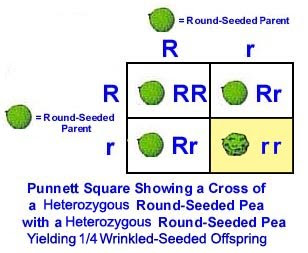
This diagram shows Punnett square. This square helps to discover the genetic combination if you have two heterozygous plants reproduce.

5facts:

Sex-linked disorders affect mostly males.

One single gene is capable of affecting many phenotype characters.

Environment we are living in may affect many characters.

We have two types of disorders recessive cause by the recessive gene and dominant disorders cause by the dominant gene.

Punnett square shows the possible gene combination based on the Mendel's hypothesizes

Key terms :
Alleles - alternative versions of a gene
Homozygous organism - organism that has two identical alleles
Heterozygous organism - organism that has two different alleles
Phenotype - organism's physical traits
Genotype - organism's genetic traits
Character - heritable feature
Trait - variant for a character
Hybrids - offsprings of two different varieties
Complete dominance - the dominant allele had the same phenotypic effect whether present in one or two copies
Incomplete dominance - some character's phenotype falls between two parental varieties


Video :

Summarize :

Chapter 9 gives a lecture about genetic informations and how are genes inherited. It describes Mendel's hypothesis and Punnett square which shows us the probability of inherited factors.

Chapter 8


Questions:
What are the phases of mitosis ?
First is interphase which lasts the longest time (about 90% of cell's life cycle) during this phase cell performs normal actions. Also this p
hase is divided into 3 sub-phases G1, S (division of DNA), G2. After interphase prophase follows. During prophase cell looses the nucleus and chromosomes become visible. Then there's prometaphase during this phase spindle is created. At metaphase chromosomes align on the metaphase plate. Then during anaphase the chromosomes separate and move toward the pole's of the cell. Telophase is finishing up the division and cytokinesis divides cytoplasm.

What is the difference between cytokinesis and mitosis ?
Cytokinesis represents the process of cytoplasmic division. Also during cytokinesis the cell finally separates into two daughter cells. On the other hand mitosis represents only the division of nucleus and chromosomes.

What is the difference between the products of Mitosis and Meiosis ?
The main difference between the products of Meiosis and Mitosis is that Meiosis produces cells with haploid number of chromosomes (23 for humans); Meiosis leads into creation of four daughter cells not two and these four cells are sex cells (sperm and egg).

Diagram:

This diagram shows Mitosis. The process and sub phases of Mitosis are described in Question 1.

5facts :

Mitosis is cell division.

Due to cross overs during Meiosis the daughter cells have different genetic variation than parent cells.

Meiosis produces four haploid cells and mitosis produces two diploid cells.

Karyotype is display of magnified images that helps the doctor diagnose any chromosomal diseases.

Down's syndrome is one of the most common chromosome number abnormality.

Key terms :
Karyotype - display of magnified images of an individual's chromosomes
Genetic recombination - the production of gene combinations different from those carried by the original chromosomes
Diploid cells - cells with two homologous sets of chromosomes
Haploid cells - cells with a single chromosome set
Fertilization - process when egg and sperm fuse together
Zygote - the resulting fertilized egg
Sex chromosomes - X and Y chromosomes
Autosomes - 22 pairs of chromosomes (sex chromosomes are not included)
Somatic cell - typical cell in human body
Tumor - an abnormally growing mass of body cells

Video :

Summarize : Chapter 8 was presenting Mitosis and Meiosis. The process of cell reproduction and also the abnormalities that can arise from mistakes during the cell division.


Friday, December 10, 2010

Chapter 7

Questions:

Why is photosynthesis so important ?
Photosynthesis creates oxygen out of CO2. That is very important especially for living organisms that need oxygen to be able to breathe.

What does photosynthesis use to make energy ?
At first the plant absorbs light and uses H2O to produce O2. During this time photosynthesis also creates NADPH and ATP so the plant can use it in second process to create sugar out of CO2

What happens during Calvin cycle ?
Calvin cycle occurs in the stroma of the chloroplast. It is a serie of r
eactions that assembles sugar molecules using CO2 and the energy containing products of the light reactions. this stage is named after Melvin Calvin. During this stage happens the most important process the change from inorganic material into organic material.

Diagram :
This diagram shows overall process of photosynthesis. It also shows the flow of ATP and NADPH between the Photosystem I and II and Calvin cycle , which is very important for the phases of photosynthesis.

5facts:

Light reactions include the steps that convert light energy into chemical energy.

Chlorophyll a is light-absorbing pigment in the chloroplast. Chlorophyll plays main role during photosynthesis.

Plants produces O2 as a secondary product of photosynthesis.

Some plants such as C4 and CAM plants are able to save water better than C3 plants, because they first fixate CO2 into a four-carbon compound not three-carbon compound (Calvin cycle).

Photosynthesis can be divided into 2 phases. 1 is when the plant needs light and the 2 is when plant can sustain the process of photosynthesis without light.

Key terms :
Mesophyll - green tissue in the interior of the leaf
Thylakoids - interconnected membranous sacs
Stroma - thick fluid filling up chloroplast
Chlorophyll - light-absorbing pigment
Photoautotrophs - organisms that are able to produce organic molecules from inorganic molecule using the energy of light
Photon - fixed quantity of light energy
Wavelength - distance between the crests of two adjacent waves
Photosystem - consists of a number of light-harvesting complexes
C3 plants - called because the first organic compound produced is three-carbon compound 3-PGA
Global warning - slow but steady rise in the Earth's temperature

Video :

Summarize :

This chapter explained the process of photosynthesis. The way plants can transform inorganic molecules into organic molecules. It described the way the light is accepted by chlorophyll and how the process continues inside Photosystems I and II and how it finishes up in Calvin cycle

Chapter 6

Questions :
What are the three main stages of cellular respiration ?
First stage is Glycolysis (breaking of glucose into pyruvate); the second stage is the Citric acid cycle (completes the the breakdown of glucose by decomposing a derivative of pyruvate to carbon dioxide); the third stage is Oxidative phosphorylation (here is generated H+ concentration and and thanks to electron transport chain the H+ molecules are transported back during chemiosmosis to generate A
TP).

What can interrupt cellular respiration ?
Certain poisons can block the cellular respiration. For example Cyanide and carbon monoxide, they bind with an electron carrier in forth protein complex. Cause of that electron cease to flow through and this stops the cellular respiration.
Another poison is oligomycin which blocks the passage of H+ through the channel in ATP synthase.

What is the outcome of ATP's for each phase ?
Glycolysis produces outcome of 2 ATPs and 2 NADH. Citric acid cycle produces 2 ATP, 6 NADH and 2 FADH2 . The oxidative phosphorylation produces the biggest number of ATP about 34 ATP molecules.

Diagram :

This diagram shows the citric acid cycle during which we breath out CO2. It's very complex cycle of reactions that repeats twice per molecule of glucose.

5facts :
Oxidative phosphorylation creates the biggest outcome of ATP (around 34).

Photosynthesis and cellular respiration provide energy for life.

C6H12O6 +6O2 -> 6CO2 + 6H2O + ATP energy - this is equation of cellular respiration.

Certain poisons are able to stop the process of cellular respiration .

Fermentation enables cells to produce ATP without oxygen.

Key terms:
Redox reaction - movement of electrons from one molecule to another
Oxidation - loss of electrons from one substance
Reduction - gain of electrons from one substance
Obligate anaerobes - prokaryotes that are poisoned by oxygen, they require only anaerobic conditions
Facultative anaerobes - can make ATP by either fermentation or oxidative phosphorylation
Lactic acid fermentation - process that enables the cell to create ATP without oxygen, some types of bacteria can regenerate NAD+
Intermediates - compounds that form between the initial reactant and the final product
Glycolysis - begins cellular respiration by breaking glucose into pyruvate
Kilocalories - the quantity of heat required to raise the temperature of 1 kilogram of water by 1C

Video :

Summarize:

Chapter 6 described the cellular respiration. Basically the process that is going on inside our body everyday. It described the Citric acid cycle which is very important because it's the cell breathing. During this process we breath in O2 and breath out CO2. Also this chapter explained other phases of cellular respiration as well, such as glycolysis and oxidative phosphorylation during which our cells create most of ATP molecules.